
At Padmini Industries Ltd, our mission has remained unchanged for more than 35 years — to protect lives and property through reliable fire-fighting equipment and high-performance rubber hose solutions. Established in 1986 by Mr. S.K. Jain and his brothers, Padmini began as a small trading unit supplying industrial hoses. By 1989, we moved into full-scale manufacturing and expanded into fire safety in 2002.
Today, Padmini operates from a 4000 sq. meter manufacturing facility in Dundhera, District Baghpat, Uttar Pradesh, equipped with modern machinery, strict quality protocols, and a skilled workforce. From BIS-certified portable extinguishers to full suppression systems, we offer complete fire safety under one roof.
One of the most common questions we receive from customers is:
This detailed guide explains the working principle, use cases, fire class performance, pros-cons, maintenance needs and refilling comparison of each type to help you choose the correct extinguisher for your environment.
1. What Are These Fire Extinguisher Types?
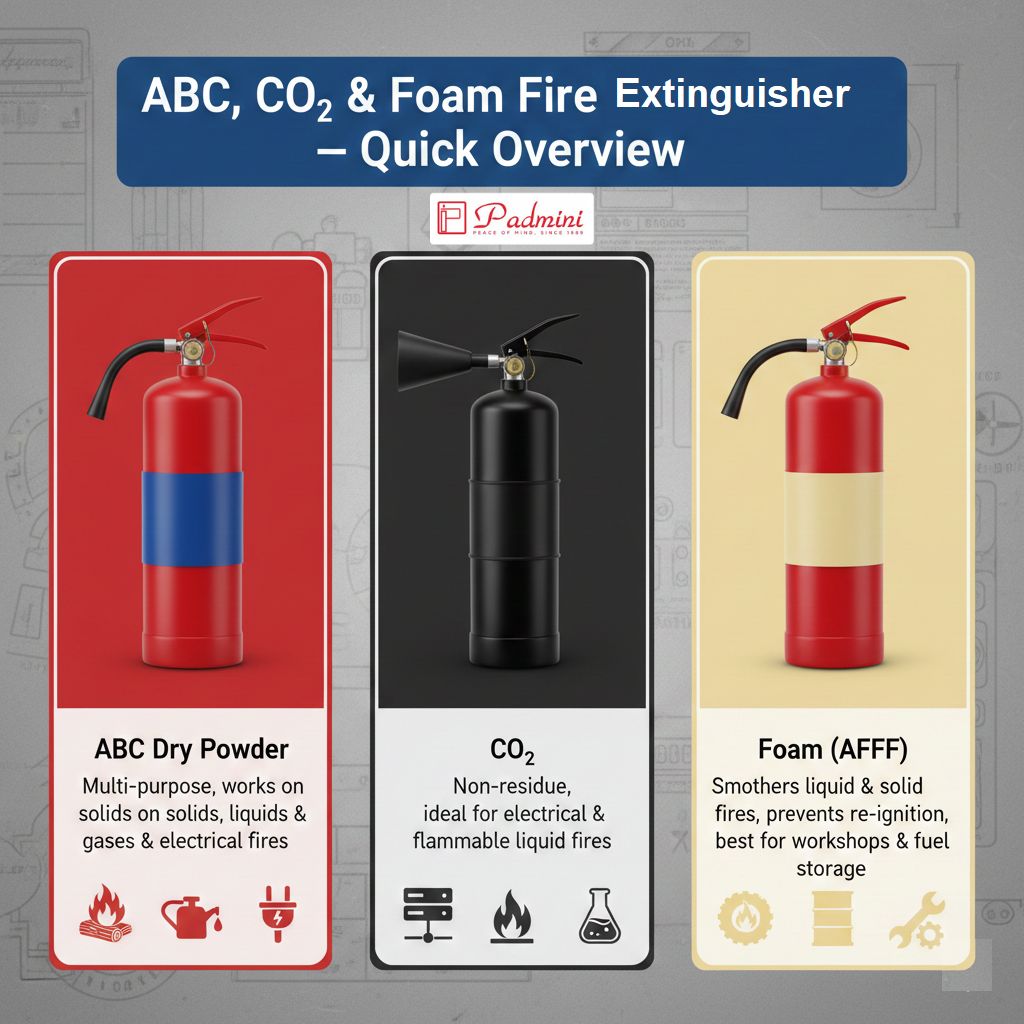
ABC Dry Powder Fire Extinguisher (Multi-Purpose)
Uses mono ammonium phosphate powder to break the chemical reaction of fire. Works on Class A, B, C and electrical fires.
CO₂ (Carbon Dioxide) Fire Extinguisher
Uses pressurised CO₂ gas to remove oxygen around the fire. Best for electrical and Class B fires.
Foam (AFFF) Fire Extinguisher
Discharges an aqueous foam layer that cools and smothers the fire. Ideal for Class A and B liquid fires.
2. Comparison Chart: ABC vs CO₂ vs Foam
| Feature | ABC Dry Powder | CO₂ | Foam (AFFF) |
|---|---|---|---|
| Works On Fire Class | A, B, C, Electrical | B, Electrical | A, B |
| Main Extinguishing Method | Breaks chemical chain reaction | Removes oxygen | Forms foam blanket & cools fuel |
| Best For | Homes, offices, industrial areas | Server rooms, panels, electronics | Fuel spills, workshops, garages |
| Residue | Heavy powder residue | No residue | Light foam residue |
| Safety Around Equipment | Not safe for sensitive machinery | Safe | Not recommended for electronics |
| Cost | Moderate | Higher | Moderate |
| Ease of Use | Very easy | Easy | Easy |
| Post-Fire Clean-up | Difficult | No cleaning needed | Moderate cleaning |
3. How Each Fire Extinguisher Works
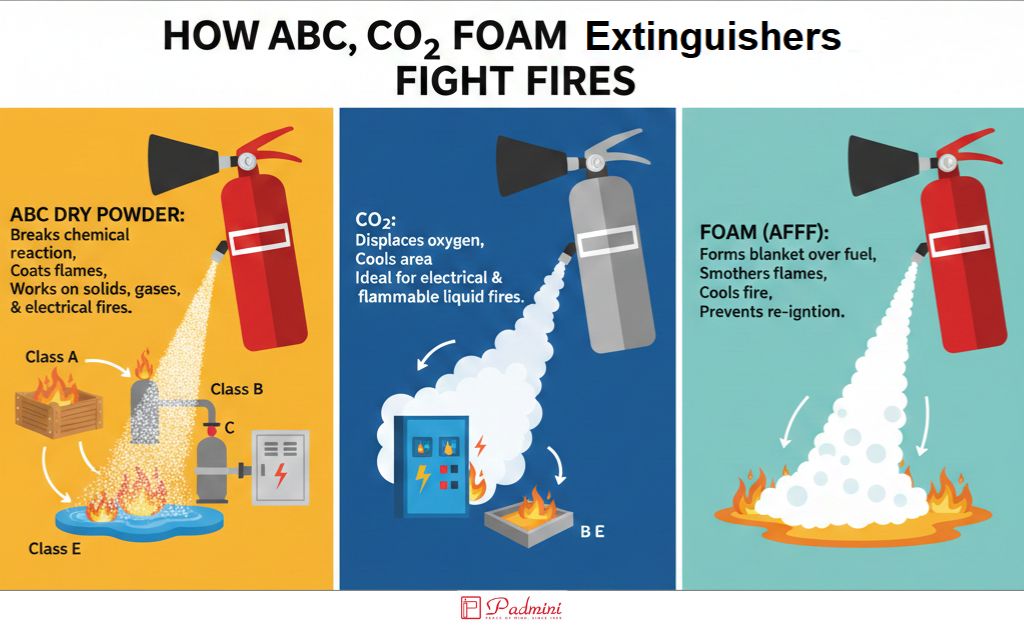
ABC Extinguisher — How It Works
- Discharges fine mono ammonium phosphate powder.
- The powder melts and forms a sticky coating over the burning material.
- Cuts off oxygen + stops the chemical reaction simultaneously.
Why customers choose it:
It is the most adaptable extinguisher for Indian environments where fire risks vary.
CO₂ Extinguisher — How It Works
- Releases high-pressure carbon dioxide gas.
- CO₂ displaces oxygen around the flame.
- The temperature of CO₂ is extremely cold, giving a slight cooling effect.
Why it matters:
CO₂ leaves no residue, making it perfect for electrical and electronic applications.
Foam (AFFF) Extinguisher — How It Works
- Sprays aqueous film-forming foam.
- Creates a blanket to cut off oxygen supply.
- Cools down the fuel and prevents re-ignition.
Why industries prefer it:
Ideal for flamable liquids, diesel storage, workshops, mechanical shops, fuel stations etc.
4. Performance in Different Fire Classes
Class A (Solid Combustibles)
- Best: ABC & Foam
- Not suitable: CO₂ (limited effect)
Class B (Flammable Liquids)
- Best: Foam
- Good: CO₂
- Works but messy: ABC
Class C (Flammable Gases)
- Best: ABC
- Not suitable: Foam & CO₂
Electrical Fires
- Best: CO₂
- Good: ABC
- Not suitable: Foam
5. Pros and Cons of Each Type
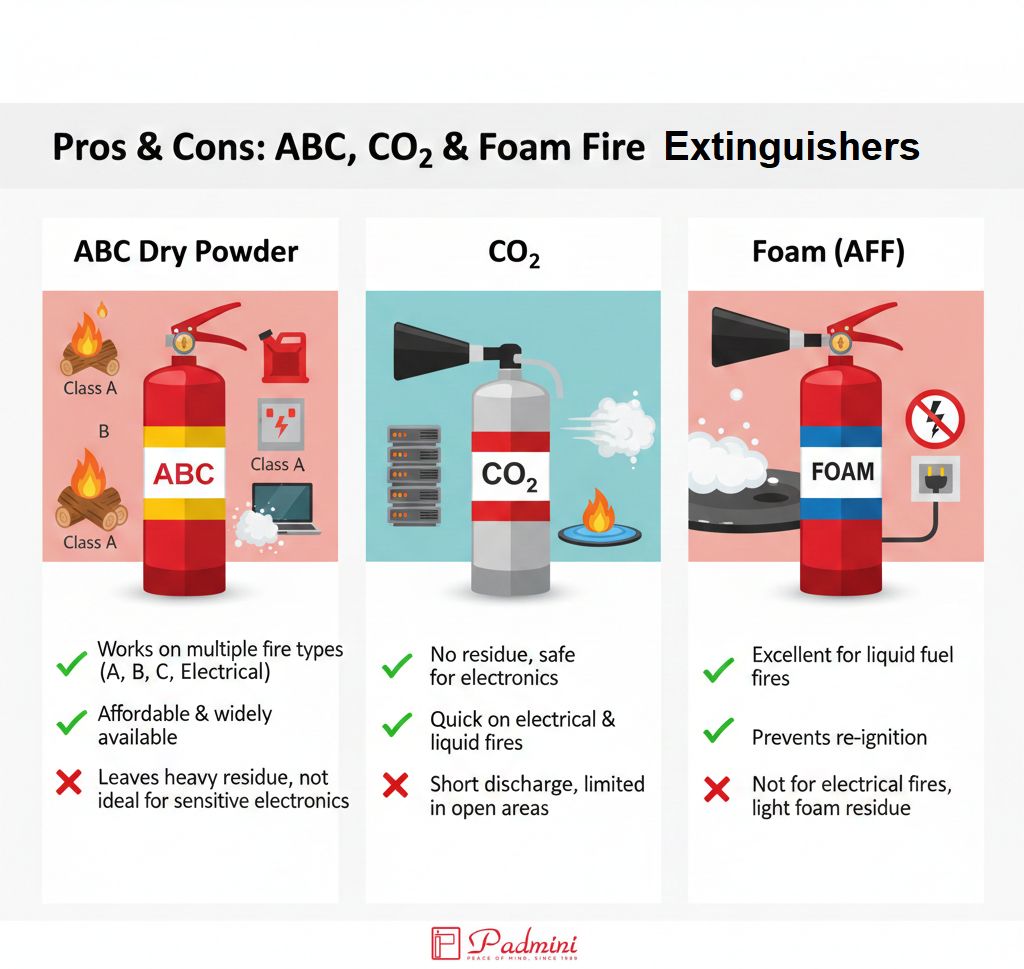
ABC Dry Powder
Pros
- Works on multiple fire classes
- Affordable and widely available
- Strong fire-knockdown capability
Cons
- Leaves heavy residue
- Not suitable for sensitive electrical equipment
- Cleaning required after discharge
CO₂ Fire Extinguisher
Pros
- No residue — safe for electronics
- Quick action on electrical fires
- Non-conductive
Cons
- Ineffective in open or windy areas
- Short discharge time
- Risk of cold burns if mishandled
Foam (AFFF) Fire Extinguisher
Pros
- Best for liquid fuel fires
- Prevents re-ignition
- Good cooling action
Cons
- Not suitable for electrical fires
- Leaves some foam residue
- Needs proper training to use effectively
6. Maintenance & Refilling Comparison
| Maintenance Area | ABC | CO₂ | Foam |
|---|---|---|---|
| Annual Servicing | Required | Required | Required |
| Refilling Frequency | After every use | After every use | After every use |
| Spare Parts Availability | High | Moderate | High |
| Valve & Hose Checks | Easy | Moderate | Easy |
| Shelf Life | 5 years (typical) | 10 years (typical) | 5 years (typical) |
| Pressure Gauge Check | Yes | No (weighed instead) | Yes |
General rule:
All extinguishers must be inspected yearly and pressure-checked every month.
At Padmini Industries, we provide refilling, AMC servicing, spare parts and pressure testing for all types of extinguishers.
7. Which Fire Extinguisher Should You Choose?
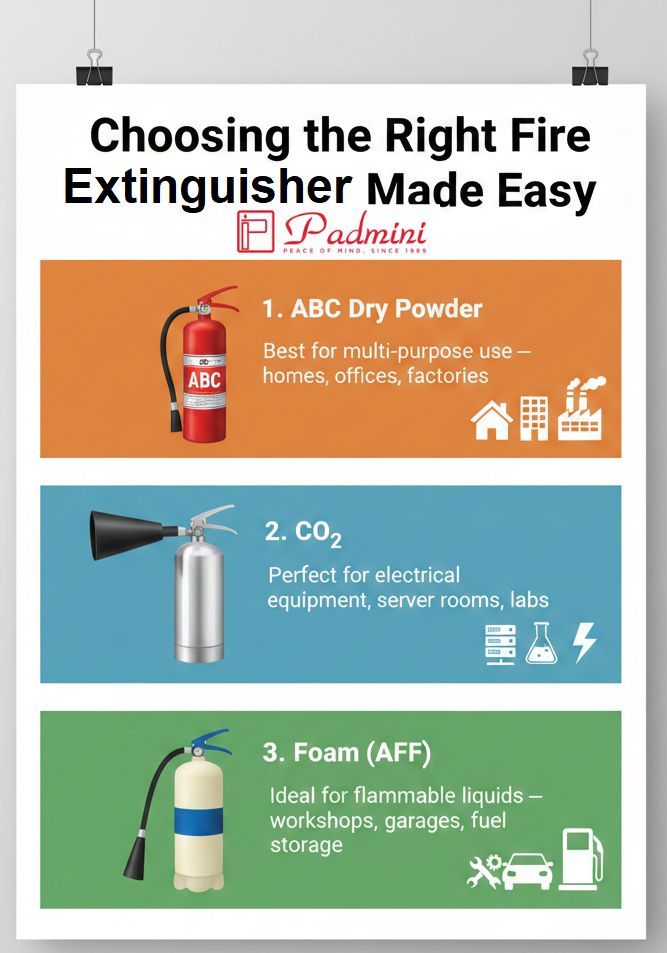
Choose ABC if:
- You want a single extinguisher for multiple risks
- Suitable for homes, offices, malls, factories
Choose CO₂ if:
- You have server rooms, panels, laboratory equipment, electronics
Choose Foam (AFFF) if:
- You work with flammable liquids
- Ideal for mechanical shops, warehouses, automotive units
Conclusion
Choosing the right fire extinguisher is not optional — it is a responsibility. The wrong selection can lead to property damage, system failure or uncontrolled fire spread.
At Padmini Industries Ltd, we help businesses across India make the correct choice through certified products, expert guidance and decades of fire-safety experience.
CTA
Need the right fire extinguisher for your facility?
Contact us for certified ABC, CO₂, Foam and other ISI-marked fire extinguishers tailored to your industry.




Leave a Reply