
Fire extinguishers are among the first lines of defence in any commercial building. But their effectiveness depends entirely on where they are installed. An extinguisher placed too high, too far, or behind furniture becomes useless during an emergency.
This guide explains the ideal mounting height, placement distances, building-code compliance, and real zone-mapping examples—designed especially for commercial buildings in India.
It also reflects over 35 years of on-ground manufacturing and safety experience of Padmini Industries Ltd, a trusted supplier of certified fire-fighting equipment.
Why Correct Extinguisher Placement Matters

Commercial spaces such as offices, malls, warehouses, hotels, and institutions face multiple fire hazards—electrical panels, cooking areas, machinery sections, storage units, and more. Incorrect placement leads to:
- Delayed response time
- Difficult accessibility
- Violation of safety norms
- Higher damage during incidents
- Legal penalties during audits
At Padmini Industries Ltd, our field teams regularly find extinguishers mounted too high, blocked behind furniture, or installed in the wrong zones. This article helps you avoid these mistakes.
1. Ideal Mounting Height for Fire Extinguishers
Indian safety guidelines and global best practices recommend:
✔️ For 4–9 kg extinguishers:
- Top of extinguisher height: Maximum 1.5 metres from the floor
- Bottom height: Minimum 1 metre from floor level
- Should be mounted on a wall bracket or placed in a cabinet
✔️ For small 2 kg / 3 kg extinguishers:
- Top height: Maximum 1.2 metres
✔️ Heavy extinguishers (wheeled units):
- Should be placed directly on the floor
- Must remain unobstructed for movement
Why this height matters:
During emergencies, smoke reduces visibility and panic restricts movement. Lower, consistent mounting height ensures immediate reach for anyone.
2. Recommended Maximum Travel Distance

Every extinguisher must be reachable within a specific walking distance.
This is mandatory for compliance.
✔️ Class A fire hazards (paper, wood, waste):
Maximum travel distance: 15 metres
✔️ Class B hazards (flammable liquids):
Maximum travel distance: 10 metres
✔️ Electrical/Electronic risk areas:
CO₂ extinguishers should be within 6–10 metres of equipment
Pro Tip from Padmini’s field audits:
Place extinguishers so an employee never has to cross a high-risk zone (like a generator room or deep pantry) to reach one.
3. Where Fire Extinguishers MUST Be Installed (Zone-Wise Guide)
Below is a practical, building-friendly layout covering nearly all Indian commercial facilities.
A. Entrances & Exit Points
- Install 1 extinguisher at every main entry/exit
- Should be clearly visible and not behind doors
- Helps occupants respond quickly while evacuating
Best Options:
- 4 kg/6 kg ABC Dry Powder
- 2 kg CO₂ for electrical panels near exits
B. Corridors & Common Areas
- Place at every 15–20 metres of corridor length
- Should not obstruct walkway
- Use glow-sign boards for visibility in smoke
Suitable Extinguishers:
- 6 kg ABC multipurpose units
C. Electrical Rooms & Server Rooms
These are among the most sensitive fire zones.
Install CO₂ extinguishers:
- 2 kg or 4.5 kg CO₂
- Mount at a reachable height
- Ensure no water- or foam-based extinguishers inside the room
Placement:
- One unit inside the room
- One unit just outside the door
This ensures backup during re-entry after discharge.
D. Machinery Areas & Workshops
- Heavy machinery generates heat and sparks
- Install extinguishers within 6–10 metres of each machine cluster
- Mount on stable walls away from vibration zone
Recommended:
- ABC extinguishers
- CO₂ extinguishers for electrical motors
E. Kitchens & Pantry Areas
- Do not install ABC extinguishers too close to stoves
- Maintain minimum 1 metre distance from cooking flame
Recommended:
- For oil & grease fires → Class K / Wet Chemical unit
- For electrical appliances → CO₂ extinguisher
F. Storage Rooms & Inventory Areas
Install extinguishers:
- At the room entrance
- At the central aisle intersection
Recommended:
- ABC extinguishers
G. Parking Areas & Basement Zones
- Basements need more units due to poor ventilation
- Place extinguishers near pillars and corners every 20 metres
Recommended:
- Foam extinguishers for fuel-related risks
- ABC extinguishers as universal backup
4. Building Code Compliance in India
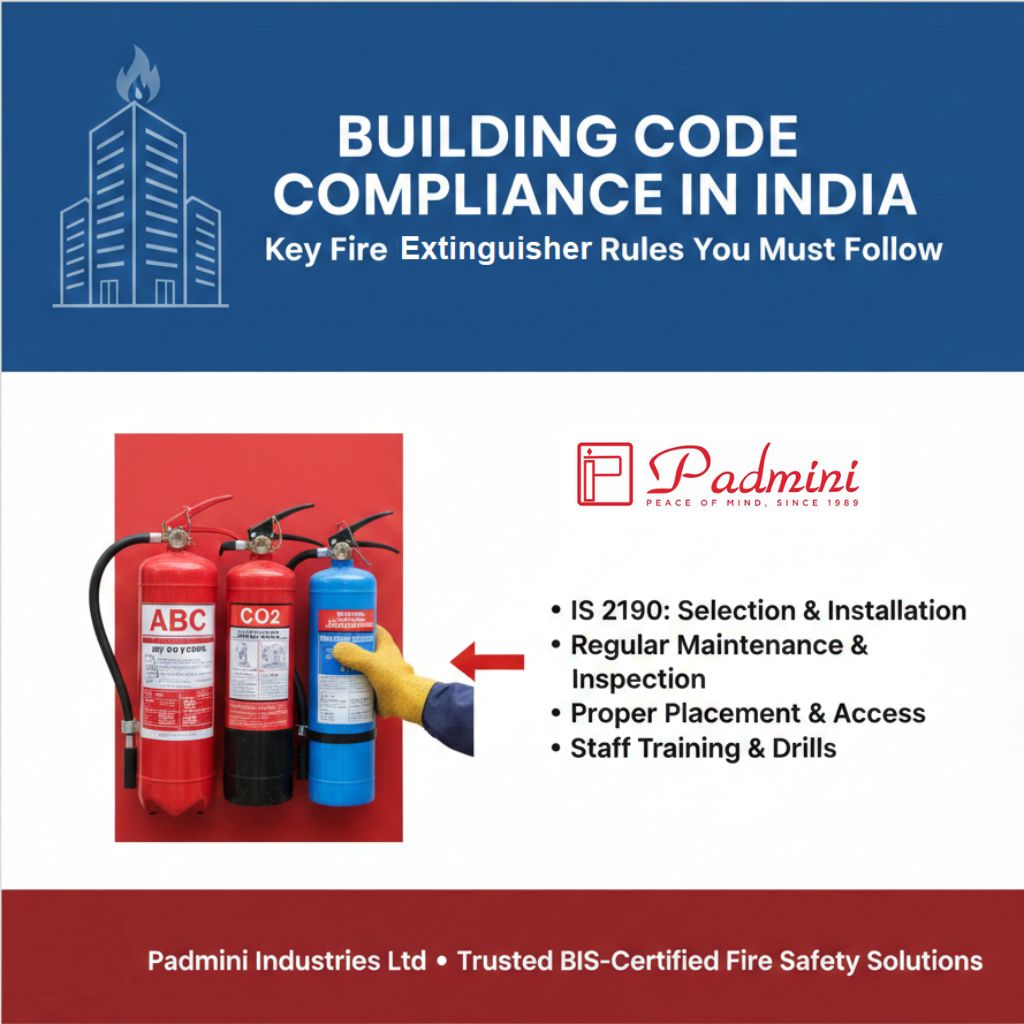
To comply with fire safety standards, commercial buildings must follow:
✔️ IS 2190 – Fire Extinguishers Selection, Installation & Maintenance
- Mandatory annual maintenance
- Proper refilling schedule
- Standard mounting & layout norms
✔️ National Building Code of India (NBC 2016) – Part 4
- Travel distance
- Hazard classification
- Minimum fire points per floor
✔️ Local Fire Department Regulations
Your district fire officer may require:
- Marked evacuation routes
- Zones with extinguisher cabinets
- Signage and glow markers
Padmini Industries supplies BIS-certified equipment that aligns with all these requirements, helping commercial clients stay audit-ready.
5. Fire Exit & Zone Mapping Examples
Below are simple, real-use examples you can apply.
Example 1: Office Floor (3000 sq. ft.)
- 1 unit at the main entrance
- 2 units at corridor midpoints
- 1 CO₂ unit near server room
- 1 ABC unit near storage room
- 1 unit near the fire exit
Example 2: Retail Store
- 1 unit at customer entry
- 1 CO₂ near billing counter (electronics)
- 1 foam/ABC near back storage
- 1 unit at emergency exit door
Example 3: Small Commercial Kitchen
- 1 Wet Chemical extinguisher near cooking line
- 1 CO₂ for electrical appliances
- 1 ABC extinguisher outside the kitchen door
6. Why Choose Padmini Industries Ltd for Fire Extinguishers & Layout Guidance

With 35+ years of manufacturing expertise, a 4000 sq. metre facility, and a strong presence across India, Padmini delivers:
- BIS-certified fire extinguishers
- CO₂, ABC, Foam & Clean Agent units
- Complete fire suppression systems
- Site Inspection & Installation services
- AMC & maintenance support
- In-house production ensuring quality & reliability
Our experience across industrial, commercial, and institutional environments allows us to create building-specific installation layouts that pass compliance checks smoothly.
Final Thoughts
Correct installation of fire extinguishers is not just a compliance requirement—it is a life-saving necessity. With the right mounting height, correct spacing, and code-aligned placement, your commercial building becomes safer and better prepared for emergencies.
CTA
Need help choosing the right extinguishers? Talk to our safety experts today.





Leave a Reply